Hip dysplasia means that the socket of the hip joint and the head of the thigh bone do not fit together perfectly; a hip dislocation is when the head has also moved out of the socket. Both are medical diagnoses made by an orthopaedic specialist. Physiotherapy does not change the shape of the joint, but it can help the muscles around the hip, movement control and load tolerance support the joint as well as possible. At MozgásKlinika Terézváros this starts with an assessment.
Who is this article for?
Mainly adults whose dysplasia was treated in childhood, or only discovered in adulthood, and who have hip, groin or lower back complaints. Screening and treating infants’ hips is a matter for paediatric orthopaedics; if your question is about your child, your paediatrician or an orthopaedic specialist is the right contact.
How can physiotherapy help?
Understanding what limits you
Where the hip hurts is not necessarily where the problem comes from. The therapist examines the hip’s range of motion, the strength and activation of the surrounding muscles, the stability of the pelvis and trunk, your walking, and how the lower back and knee work. Your results and your doctor’s advice are weighed together with the examination.
Strength and movement control
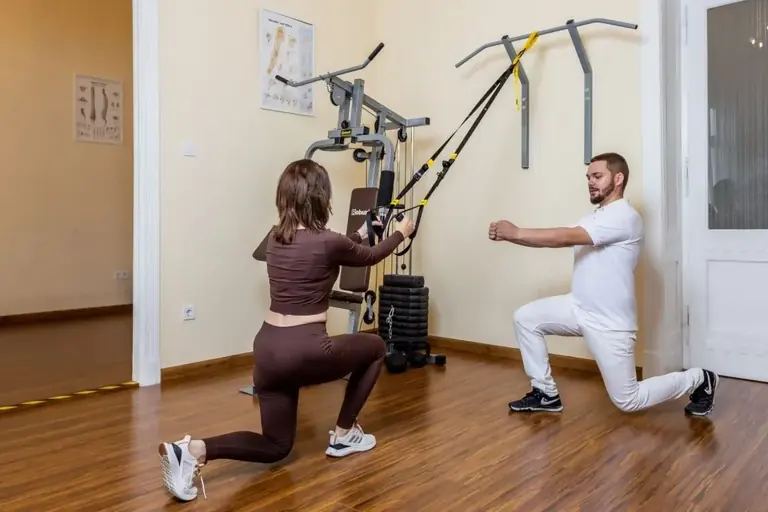
When the bony support of the joint is less favourable, the muscles around it may matter more. “More strengthening” is not always the first step: sometimes the right muscle activation and control of movement have to be relearned first.
Dosing the load
Part of treatment is working out which loads provoke the complaint and how everyday or sporting load can be rebuilt gradually. The levels of the MozgásPiramis® serve as a compass here too.
What is recommended in your case, and what the clinic can offer, is something the therapist tells you after the assessment.
What can physiotherapy not do?
It does not “put the joint back”, and it does not replace orthopaedic follow-up. If your doctor recommends surgery, the physiotherapist can help with preparation and with rehabilitation afterwards.
If a hip complaint keeps limiting you, book a consultation (opens in a new tab).
When not to wait
See a doctor promptly if:
- the pain started after a fall or an accident;
- it comes with fever, unexplained weight loss or feeling generally unwell;
- you notice numbness or weakness in an arm or a leg, or it is getting worse;
- your bladder or bowel control has changed, or you have lost feeling around the saddle area: this is an emergency;
- you have pain at night that does not ease at rest.
Get immediate medical help if you cannot put weight on the leg after a fall, or if the hip suddenly “locks” with severe pain.
Frequently asked questions
Can I do sport with hip dysplasia?
That depends on the state of the joint and your complaints, so your orthopaedic doctor and the therapist can advise together. The aim is usually not to forbid movement but to find the right load.
Should I bring my X-ray or MRI report?
Yes, if you have one. The therapist reviews it at the first visit; see what happens at your first visit.
Does it make sense in later life?
Yes, the goals are adapted to your condition. See musculoskeletal complaints in older age.
Hip dysplasia is a given, but how much load your hip can take is partly trainable. Book a consultation (opens in a new tab)